I haven’t been volunteering as long as many ladies at Bayview hospital, located right next door to me, at 27 Lakeshore, Pointe Claire, QC. But I’ve come to love the staff, residents and volunteers there. The summer view of bay Valois can be breathtaking. You’ll see a few residents out with their family or volunteers.
I am seriously disabled from a stroke and can’t work. My schedule is busy with doctor appointments but I found I had extra time on my hands so I walked into the hospital and spoke with the volunteer coordinator to apply. I could only give a few hours per week but every hour is precious. Here’s why.
Maggie Riley, 87, independent but wheelchair bound. She never married, put her career first and had no children. She travelled in Canada extensively. She had worked at Bell for many years. Not sure of exact times, I never pushed for details! Her brain was foggy at times and I was told to listen to her talk. She loved and missed her long-time dog friend! The Pet therapy visited her. Her face would light up and you could see the beautiful young woman she was!! Blue eyes that pierced right through you if she was mad. A die hard Canadians fan who enjoyed wearing the cap on her head to shade her from sun on our numerous walks on the lakeshore or the pic-nic at Bayview Park.
For me to push another individual in wheelchair made me feel grateful. I could walk now and had regained my own autonomy.
Covid came and all visiting was stopped!! I called Maggie often. When she picked up, we’d talk. I was so happy to hear her voice!! Living alone through this time has been difficult for me. A few days passed and I had not been able to reach Maggie. Then I got a call telling me Maggie had died from Covid. I was devastated.
I think the volunteer coordinator saw we (the Bayview volunteers) needed a pick me up during isolation, and Zoom meetings were held regularly thereafter.
The “volunteering on the move” interuniversity research team is currently carrying out a research project on volunteer practices and the plural civic implications existing in non-profit communities and organizations in Quebec.This research project is a continuation of a first research project on the plural meanings associated with volunteering in Montreal and its surroundings.
Presentation of the research project As part of this new research, we are paying particular attention to the meanings, experiences and practices of individuals with volunteer or civic involvement and who self-identify with a minority.
To participate in this project, you must correspond to the following profile: (1) you must feel that you are affiliated with a minority. For example, you might feel that you are a member of an ethical or linguistic minority, a religious or political minority, part of the LGBTQ2S + community or the BIPOC / PANDC community, or of an immigrant background or be disabled.
(2) you must do some form of volunteering or civic involvement. For example, your involvement could take the form of a one-off involvement or commitment in an organization or a collective, of a mutual aid or solidarity activity towards a certain community or even of militant involvement.
The objective of our research is to better understand the ways in which these individuals perceive their own volunteer or civic activities and the ways they look at the organizations and environments associated with volunteering and citizen mobilization in Quebec.
How to participate Interviews are individual and/or group. One-on-one interviews last one hour (maximum), and group interviews two hours (maximum). We invite participants to specify their modalities of participation, among the following three options:
Participation in an individual interview
Participation in a group interview
Participation in the individual and group interview
Interviews will begin in August 2021.
Research purposes By participating in this research, participants will help promote their practices and organizations in academia and with other partners in the field of volunteering and citizen involvement, while contributing to the development of knowledge in the field.
A written research report will be submitted at the end of the study, and will be available for consultation. This study will make it possible to take into account the vast set of practices and cultures of volunteering and citizen mobilization in Quebec.
To contact us If you are interested in participating in this research or if you know someone who could be, we invite you to subscribe or share this link.
In addition, the project director, Consuelo Vasquez, is available for a telephone appointment to explain in more detail the terms of participation in the research: vasquez.consuelo@uqam.ca.
The prevalence of bureaucratic obstacles that prevent volunteers doing what they came to do was one of the key motivations that pushed me to research changes in nonprofit organizing and volunteering in the first place. Nonetheless, demands for “expert volunteers” who complete various training modules still surprise me.
A recent example from a family member in New Zealand who had been volunteering for an environmental organization for several years was a case in point. Let’s call him Stephen. Stephen protects native flora and fauna for New Zealanders to enjoy by trapping predators and by clearing branches and scrub that have fallen onto walking tracks in mountainous and forested regions. Clearing paths often requires the use of a chainsaw. The organization insisted that in order to comply with occupational health and safety regulations, all volunteers had to obtain a certificate to show that they knew how to wield a chainsaw safely. Stephen didn’t see the need for a certificate: he’s used a chainsaw for years – at home, at work, and even more surprisingly for the very same organization that now wants him to become certified.
However, since it was impossible to continue volunteering for the environmental organization without the certificate, he felt obliged to enrol in the four-day training program together with two other participants. He didn’t enjoy the course. There were too many rules and regulations that were going to make volunteering difficult if not impossible: rules about passengers transported to the site in a van, regulations about whistles to be used if the person chain-sawing were to slip and hit his/her head…
At the end of the course, the instructor gave out a pen and paper test to check that the participants’ chainsaw knowledge was up to scratch. Stephen answered the numerous questions in a way that he felt combined concision and precision, and so he was dumbfounded when the instructor informed him that all three of them had failed the exam. He had failed because his answers did not use the same wording as the manual that had been given out with other course materials at the beginning of the course. The now very dissatisfied participants contacted the National Office to complain about how the procedures had stopped them from staying involved with a leisure activity that they all enjoyed.
A few months later, a manager from National Office called back and conducted a thorough, forty-five minute long oral examination by phone, interjecting negatively when Stephen couldn’t remember some specific details. Toward the end of the exam, the manager asked for a list of twelve possible safety hazards to watch out for when chain-sawing. Stephen rattled off eight potential dangers quickly but petered out once he got to nine or ten.
He added in half jokingly that it would be very important to watch out for herds of wild deer and even wild pigs, since they could cause an absolute ruckus. Once he had convinced the manager that this did indeed happen in the high country, he noted that her rather cold tone changed to sincere interest and he heard her pen scratching on her note pad at the other end of the line. Stephen has stopped going to the organization’s meetings, as they only argue about which regulations matter and how they might be implemented.
Some references on bureaucratization and professionalization of volunteering:
Ganesh, S., &McAllum, K. (2012). Volunteering and professionalization: Trends in tension?. Management Communication Quarterly, 26(1), 152-158.
McAllum, K. (2018). Volunteers as Boundary Workers: Negotiating Tensions Between Volunteerism and Professionalism in Nonprofit Organizations. Management Communication Quarterly, 00(0), 1‑31.
Kreutzer, K., & Jäger, U. (2011). Volunteering Versus Managerialism: Conflict Over Organizational Identity in Voluntary Associations. Nonprofit and Voluntary Sector Quarterly, 40(4), 634‑661.
For three years, I have been passionately involved in a professional association labelled as a non-profit organization (NPO). The mission of the Association du design urbain du Québec (ADUQ; Urban Design Association of Quebec) is to promote and to make known the practice of urban design. Urban design is a field in emergent state that seeks to contribute to the renewal of today’s city and benefits to our “living together” following a human scale approach. The mode of existence of ADUQ, in 2018, is essentially based on volunteering. This volunteering force works to embody their mission by placing itself at the articulation of the various elements constituting the urban design field, thus creating networks and promoting the dissemination of the day-to-day content. However, “in my day” (2012 to 2015), we operated beyond the media watch. We dedicated our energies to anchor the NPO foundations through the realization of events, written productions, the development of public spaces and through the creation of urban objects, etc.
During my involvement, I thus participated in all types of activities at the cost of several hours of implication a week, yet deeply enjoying contributing to positive changes in Montreal’s urban lifestyle. I had the feeling to improve the well-being of Montrealers but also of the planet, since a human scale city is less harmful for the environment. More specifically during my years with ADUQ, I was one of the instigators of the Village Éphémère (Ephemeral Village), today known as the Village du Pied-du-Courant.
Image by Jean-Michel Seminaro
The Village Éphémère had as an objective to reveal an under-exploited urban space as well as to highlight the new generation of professionals linked to the planning field. The idea of implementing this event emerged while all ADUQ members were more and more breathless. Indeed, for nearly two years that the group was volunteering to build its legitimacy. Thus, the seed of the Village Éphémère did not immediately (never has) unanimity among the members, that is why the major part of its organization was the work of few individuals. Nevertheless, this work was under the seal of ADUQ, because acquiring personal credits for the benefit of the association’s mode of existence was not questionable. In 2013, we successfully held a first edition and, spurred on by this success, in 2014 we came back for a second (and last!) edition.
Given the scale of the project compared to our almost inexisting resources, the adventure of the Village Éphémère is fraught of many tensions. For examples, those tensions had materialized between the members of ADUQ or with our various collaborators, with the public space or the material for construction, and with the weather as well obviously. I can qualify these tensions as being both productive or harmful, either because they were sometimes energy-consuming or because they fuelled our attachment to the project.
There are multiple avenues to this story. However, choosing a direction here was quite simple, it seemed relevant to me to share with you the hidden side of the volunteer practice I experienced. Why not discuss the tensions that can inhabit the heart of a volunteer? In other words, I dare to talk about the “dark side” of the volunteer.
Image by Jean-Michel Seminaro
During the process of the Village Éphémère and long after my disengagement from the project and the association, I was deeply inhabited by a specific tension. I was caught between the anonymity required by my “Aduqian” position (we were a group and not individuals) and the tacit principle of disinterestedness that underlies the voluntary act, with the desire to be recognized for my decisive role in the project’s success. Moreover, I felt this tension tenfold because I judged this desire pernicious in a context where I was acting for a cause. My dedication to the cause was boundless, to the point of affecting other spheres of my personal life: the project would not have been able to flourish without my participation limitless (that said very humbly I assure you). From its earliest days, the Village was a great success and paved the way for many other “ephemeral” projects—nowadays, we can cross a “ephemeral” project per square kilometre in Montreal! To this day, while some of my fellow are associated with this project, giving them legitimacy and admiration, my work is still hidden in the shadows.
I reassure you, writing these words I am no longer consumed by this dilemma between my involvement, which was by definition selfless, and my need for recognition and esteem by my peers. The experience has shown me, on the one hand, to fill myself with the appreciation of the people who are dear to me and whose judgment I truly value and, on the other hand, to smile at the memory of this very human need for recognition.
Hoping that this brief confession will make some of you not feel guilty of experiencing such feelings. The need for congratulation and recognition, even if we feel the context does not lend itself to it, is human. It may be better to recognize it and forgive yourself of our humanness, thus avoiding sinking in the “dark side”, and get caught up in a spiral of frustrations!
I enter the ballroom wondering if I’m dressed appropriately for this event. The vast room of the montrealer hotel, decorated with suspended chandeliers, is crowded with middle-aged people, mostly white women. I try to make my way through this happy and noisy mass of people, hoping to recognize a familiar face. Among the hundred round tables dressed in white, I finally find the one where are sitted the employees of Ensemble (pseudonym), a non-profit organization (NPO) in the field of health, who invited me to participate to the event. After greeting them and shaking their hands with my best smile, I sit down, place my conference badge around my neck and consult the schedule of the day. The conference on volunteering is about to start.
On stage, I recognize the Human Resources manageer (HR) that I interviewed a few weeks ago. How does she manage to always be so clean, fresh and radiant? I wonder. A well-dressed man (just as fresh and radiant) is standing next to her – probably one of them, I think. Indeed, I will learn later that this man was a consultant hired by Ensemble to develop a new volunteer program to increase recruitment and retention (that was what I thought: one of ” them “). At nine o’clock sharp, the two speakers on stage open the ball by presenting the vision of volunteering for years to come. The argument is quite simple: volunteering is at the heart of Ensemble; to increase volunteer involvement, “we” need to know who the volunteers are; and, therefore, “we” must offer different volunteer opportunities. In addition, Ensemble supports an image of a fairly common volunteer: a “good” person who gives her time for a “good” cause.
I look around me and wonder if this definition corresponds to those who are listenning to this presentation: are we “good” volunteers? I cannot tell. Anyway, according to the comments of the two speakers, the people present here represent Ensemble‘s volunteers: white, middle-aged, French-speaking women, most of whom are involved in fundraising activities. They are what the consultant calls “the army of volunteers”. What a strange expression to talk about these kind and good volunteers who are willing to give their time for the cause. I have some difficulty imagining them armed to fight against a common enemy. Besides, who is this enemy? The answer will come from the HR manager: the enemies are the 200 other NPOs in the country in competition with Ensemble. For Ensemble to be “THE reference in the field of health”, it needs its own “army of volunteers”!
“We will have to be very competitive,” says the consultant. Does he realize he’s talking about competition, recruiting volunteers and retention strategies to volunteers? Shouldn’t these topics be addressed to employees? I’m starting to feel very uncomfortable: I do not like being put in a category – I hate categories! – but even more, I strongly believe that I have nothing to do with the volunteer profiles proposed and the motivation strategies presented by the consultant. I did not come here for a 101 HR management course! Am I the only one to feel insulted? A quick look in the room confirms my suspicion: everyone agrees and does not seem to bother. They even laugh when the consultant characterizes the Y generation as being “glued” to an electronic device.
Fortunately (for me), the HR presentation ends with a few examples of volunteering strategies being promoted by Ensemble that respond to the volunteer challenges outlined by the speakers. These initiatives are presented on a slideshow: the constitution of “volunteer leaders”, volunteer-school coordinating committees, “supra-regional councilors” and the role of “volunteer ambassador”. After each presentation, the volunteers representing each initiative stand up and are applauded. I can not help but to think that all this is too beautiful, too good, too “fresh and radiant”, as if there was something or someone invisible that was orchestrating the whole thing. And at the same time, I realize that spontaneously, I smile while applauding this group of “good” competnet and talented volunteers who offer their skills and time to Ensemble, and to whom, it would seem, that I belong. I let myself be carried by this staging, even for a moment, to feel that I am also a “good” volunteer.
Some reference to go further:
Bernardeau, D. (2018). Professionnalisation des bénévoles : compétences et référentiels. SociologieS, 24
Kesteman, M., & Monnier, E. (2005). Bénévoles et rémunérés : tous professionnels ? Pensée plurielle, 9(1), 55.
Falcoz, M., & Walter, E. (2007). Travailler dans un monde de bénévoles: Contraintes et limites de la professionnalisation dans les clubs sportifs. Revue internationale de l’économie sociale: Recma, (306, 78).
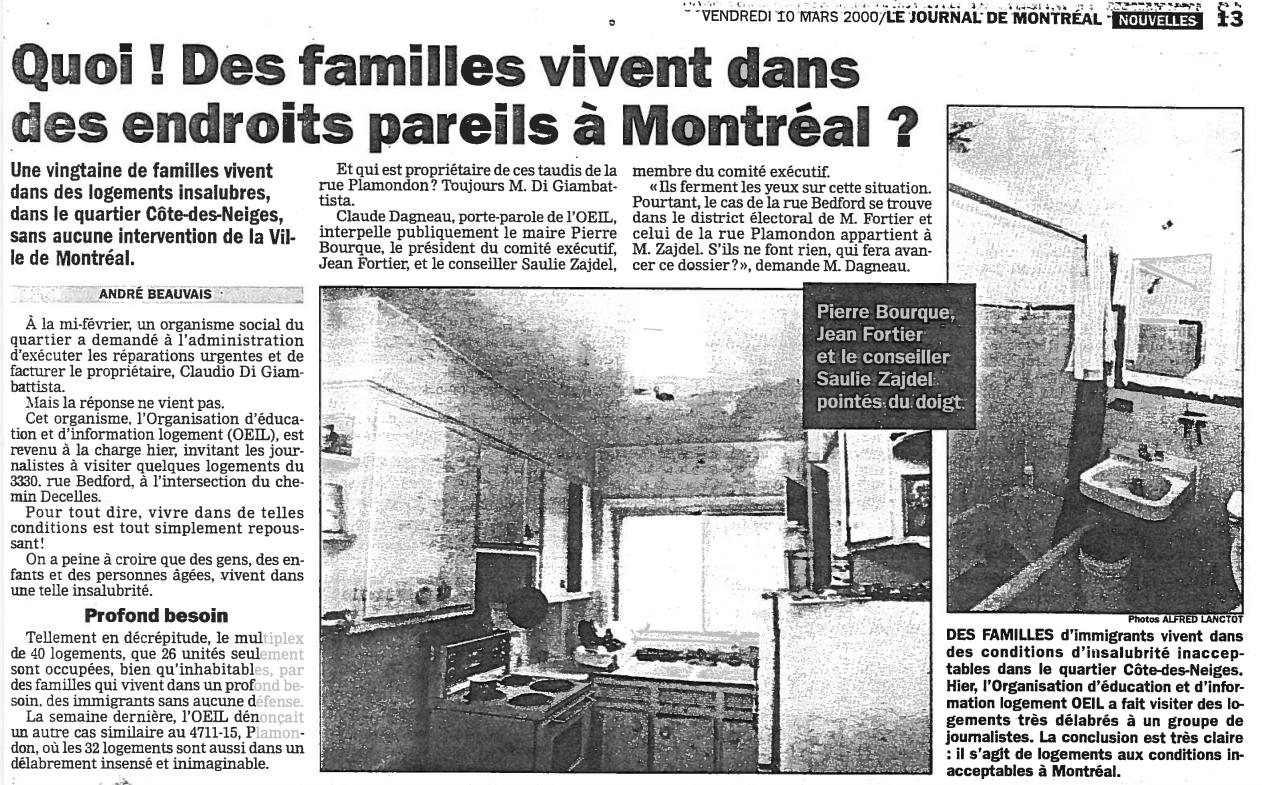
As I entered the building, the stench burned my nostrils. The air in the building smelled like nothing I had ever experienced – I would later understand this was the odor of a rare type of mold that developed following the building’s severe water infiltrations. I kept walking, following Lindsey up the stairs, although I now had a headache and felt in my guts an urge to leave this place. However, I had said I would be there to visit Sahan, a refugee claimant who had just arrived in Montreal, and had been nearly coerced to rent an apartment in this decrepit building. He had called the tenants’ association to tell how, the day before, the property owner had hit Sahan with a loose window pane, nearly injuring him, but he did not dare call the police because of his drinking problem. We were on our way to meet him.
Sahan took a while to answer when we knocked at his door. When he finally opened, we understood that he was sleeping, and probably inebriated. I thought to myself that if I had no job and lived in such a place, I would be drinking, too. The short man must have been in his forties but had a coy smile and a respectful tone that made him appear almost boyish. He took us for a tour of the apartment to show us the spots that were deteriorated, but no sooner had we taken a few steps inside that Lindsey and I, wide-eyed and mouth agape, shared a disconcerted look: the ceiling had fallen down in living room and the floor was damp with water. Mold was all over the walls and the stench was even stronger inside the apartment than it was in the hallways.
At that moment, I felt torn between two options. On the one hand, deep inside I felt that this was not meant for me: I thought I would be helping people with legal issues. I had even been hit in the face by a slum lord and could live with that. The smell, the filthy apartment, the headache, though, that was too much; I literally had not signed up for this. I was putting my health at risk, but more importantly, I found it all repulsive in a way that I could not control.
On the other hand, though, as we spoke with Sahan, I could not help but feel sorry for that man, who was an English teacher back home, escaped a war, did odd jobs all over the place, and was now just trying to mend his life back into one piece. I had the luxury of just being able to turn back, walk a few blocks, take the subway, and be sleeping in my warm bed at home. That place I found so repulsive, that was his home. He had nowhere else to go.
Photo by Felicity Tsering Chödron Hamer.
I remember thinking about this while Lindsey took pictures of the apartment. Then, almost on autopilot, I asked Sahan a few questions about the fight with the property owner and told him we would meet in a few hours at the corner to walk together to the police station for him to file a complaint. When we left, Lindsey told me: “That’s so nice of you! You didn’t have to do this, you only volunteered to accompany me.” I knew I didn’t have to, but I felt I had to do that, to help Sahan, as long as I could sleep in a dry bed and not him.
Some reference to go further:
Beyes, T. (2016). Colour and Organization Studies. Organization Studies, 0170840616663240. https://doi.org/10.1177/0170840616663240
Warren, S. (2008). Empirical Challenges in Organizational Aesthetics Research: Towards a Sensual Methodology. Organization Studies, 29(4), 559‑580. https://doi.org/10.1177/0170840607083104
Reference on this research:
Bencherki, N., & Bourgoin, A. (2017). Property and Organization Studies. Organization Studies. https://doi.org/10.1177/0170840617745922
Bencherki, N. (2012). The hybrid performance of a district, the limits of speech acts and the possibility of a material ethics: a study of the work of a tenants association in Montréal. Collegium, 13, 28–44. http://hdl.handle.net/10138/38584
Cooren, F., Bencherki, N., Chaput, M., & Vásquez, C. (2015). The Communicative Constitution of Strategy-Making: Exploring Fleeting Moments of Strategy. In D. Golsorkhi, L. Rouleau, D. Seidl, & E. Vaara (Eds.), The Cambridge Handbook of Strategy as Practice (pp. 370–393). Cambridge: Cambridge University Press. https://doi.org/10.1017/CBO9781139681032.022
Vásquez, C., Bencherki, N., Cooren, F., & Sergi, V. (2018). From ‘matters of concern’ to ‘matters of authority’: Reflecting on the performativity of strategy in writing a strategic plan. Long-Range Planning, 51(3), 417–435. https://doi.org/10.1016/j.lrp.2017.01.001