This research is based on a multi-site organizational ethnography and a collaborative research approach between the research team and three NPOs.
This type of approach relies on an observer-participant methodology. In other words, it requires both from the researchers and the NPO members to be involved in the development of research objectives and results, in a joint venture. Here is a breakdown of the aspects of our research, all the final reports are available here.
The first research partner is the Canadian cancer society (CCS). The CCS is a volunteer organization whose mission is the eradication of cancer and the improvement of the quality of life of those affected by cancer. CCS “funds research, provides services to those living with cancer, advocates on important cancer-related issues and educates and empowers people to make healthy choices” (CCS website 2019). The research team for the field with the SCC is Jeanne Barbeau, Frédérique Routhier, Emmanuelle Brindamour, Sophie Del Fa and Consuelo Vásquez (lead researcher of this case study).
The analysis focused on the event “Relay for Life”, the Canadian Cancer Society’s signature fundraising event. At a Relay, participants of all ages take turns walking around a designated track with friend and family. The goal of the event is to celebrate cancer survivors, remember those we’ve lost, and commit to raising funds for life-saving research and support services.
The expertise that the CCS has developed on volunteering in recent years, particularly in Quebec, as well as the know-how acquired in the organization of major events (and pan Canadian fundraising), are contributions that are fundamental to our research. The collaboration with the CCS and the research team is several years old. A study of one of CCS’s cancer prevention projects, Trottibus, was conducted by Consuelo Vásquez, the project’s lead researcher. Click here to read the study.
An innovative methodology
The methodology was essentially based on the follow-up of four Relay committees in the greater Montreal area. These committees, constituted by 10 to 15 volunteers, are responsible for the organization of the “Relay For Life” in their city. Accompanied by a CCS development officer, they coordinate the teams participating in the Relay, take care of the visibility of the Relay, the logistics, the supports for survivors and the management of the volunteers on the site.
The focus on the committees’ organizing activities allowed us to center the research on the communication practices and to have a longitudinal overview at the process of coordinating a volunteer fundraising initiative. More specifically, the follow-up of the Relay committees was realized through the four following research strategies:
(1) Observation of committee and subcommittee meetings, as well as outreach activities (e.g. press conferences, booth at city fairs), and fundraising (e.g. races, car wash). The observation also included the day of the Relay.
(2) Semi-structured interviews with committee members, the CCS’s development officers, and the CSC’s director responsible for Relay. We also carried out “walking interviews” with a member of each committee on the site where the Relay takes place.
(3) An ethnography of the Relay’s public broadcast websites and private networking websites set up for committee coordination, and
(4) the shadowing of a committee member on D-Day. This strategy allowed us to closely follow the course of the Relay by taking the perspective (the point of view) of the “shadowee”. In a way, the researcher becomes the shadow of the person she follows, allowing her to ‘live’ the event through to the participant’s actions and interactions.
We used audiovisual material for observation and shadowing, the aim being to access the communication practices (verbal and nonverbal) and the material dimension (space and objects) of interactions.
This research, led by Coline Sénac (UQAM), Nicolas Bencherki (TÉLUQ) and Consuelo Vásquez (UQAM), consisted in mapping the practices of volunteering in the Greater Montreal and surrounding areas. The study analyzed the position taken by actors involved in Montreal’s volunteering networks.
The objective of our study was to provide an overview of volunteer practices based on the motivations, interests and values of actors from the communities where volunteering takes place (voluntary action centers, community, social, religious and health organizations, political parties, unions, etc.) in the Greater Montreal and surrounding areas.
Research methodology
To realize our study, we carried out a qualitative study, based on semi-structured interviews with thirty actors pertaining to Montreal’s volunteering network. The choice of actors was made according to their status and their experiences within the network.
Theoretically speaking, we took inspiration from Actor Network Theory and more specifically on the analysis of socio-technical controversies; in order to draw the networks of actors of Montreal’s volunteering community. We seeked, from the stakes and practices of each of these actors, to understand their own definition of volunteering. We were particularly interested in understanding the position taken by the actors in relation to the current issues concerning the practices of volunteering in Quebec, particularly regarding the institutionalization and professionalization of volunteering.
The research continued in a second phase with an expansion of the population to include more English-speaking or immigrant people. In a second research report, entitled “acting on the margins”, we studied the communication processes that underlie the phenomena of injustice and discrimination within the fields of volunteering and civic involvement, by the analysis of specific situations that have been directly experienced by volunteers and citizens.The aim of our research was to reveal, in the way people relate the experiences and meanings they derive from these situations of injustice and discrimination, the communication practices that make them possible.
This project, led by Nicolas Bencherki (TÉLUQ) and Camille Nicol (UQAM), took place in partnership with the Côte-des-Neiges Housing Education and Information Organization (OEIL) and the Ahuntsic-Cartierville Housing Committee (CLAC). Both organizations defend tenants’ rights and call for more social and affordable housing in their neighborhoods. Their actions depend critically on their ability to mobilize residents, to empower them to defend their own rights, but also because these two organizations, like many others, lack the resources to carry out their mission.
Yet, mobilization remains an important issue among community-based organizations (CBOs). Volunteers and activists can be seen as “no-cost” human resources but, more importantly, their involvement is also at the heart of CBO values. However, volunteers and activists also have their own constraints and interests that sometimes makes it difficult for them to commit on the long term. A major challenge for organizations is therefore to decide on the place to give volunteers and activists: how to strive for a rich democratic life that gives a voice to the people most concerned by the organization’s work, while also ensuring the quality and sustainability of that work of the organization?
Methodologically, this project adopted a research-action approach, in which a member of the research team assists the members of the organization in setting up and running its volunteer and activist mobilization committee. While being directly confronted with the issues related to the involvement of volunteers and activists, this person recorded meetings, took notes and documented the process and the difficulties encountered, as well as the way members overcomed them. In this sense, research-action can be seen as a form of participatory ethnography, with the aim of both producing academic knowledge and concretely helping the people and organizations involved.
In the end, the research report proposed a social and processual framework for thinking about the relationship between attachment and detachment in volunteer involvement. In our view, engagement is a process by which a person comes to relate to others. Attachment and detachment should therefore be understood as movements on dynamic axes that vary over time. More specifically, it is possible for a volunteer to be attached to a particular organization, cause or people, but also to all three elements at the same time.
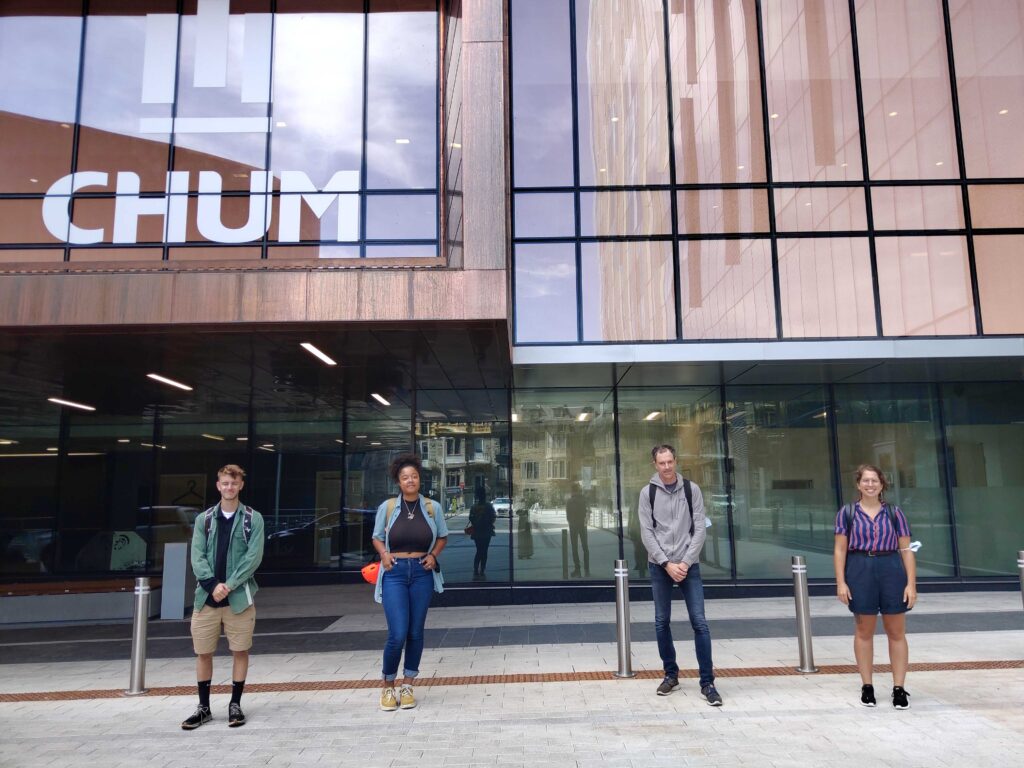
The Center Hospitalier de l’Université de Montréal (CHUM) is a university hospital that “provides the best care, specialized and subspecialized, to patients and the entire population of Quebec (.). The CHUM has a vocation of care, research, teaching, health promotion (.) “(Organization’s website). In addition, the CHUM receives approximately half a million patients annually.
Volunteering occupies a prominent place in the ecosystem of the organization. In fact, the CHUM manages various volunteer involvement programs, including reception and support, activity and leisure as well as patient support and listening, the latter program being the subject of the research project. More specifically, we aimed to better understand the experience of volunteering in a hospital environment by identifying the challenges that may arise from a practice of accompaniment and listening to patients of the oncology department.
The objective of this research was therefore to better understand the challenges and issues related to support and listening tasks in terms of personal motivation, continuing education or even links with professional services ( and paid) of the hospital center. We also explored the “management” aspect of such a program, with regard to the recruitment, supervision, retention and integration of volunteers.
The research thus aimed to better understand how the challenges and issues of volunteer practice are part of a relational dynamic with patients and their families, health professionals or any other group of people gravitating around the support program and listening. Ultimately, we hoped that this project will develop knowledge and tools that will facilitate better involvement of volunteer action at the CHUM.
To better understand these dynamics surrounding volunteer practice, we observed certain volunteers in their tasks of accompaniment and listening to patients, and this, as they take place. We recorded these practices using a mini camera so that we captured in detail what’s going on during this type of activity. In addition, we also interviewed these same volunteers, interviews which were also recorded and transcribed anonymously.
We also asked the volunteers to describe their daily activities as a companion, to tell us about their tasks, the challenges and issues they may encounter and how they see their role within the CHUM, a highly professional environment. We therefore “followed” some volunteers who voluntarily agree to participate in the research while asking them questions about the challenges that this may represent. In total, we spended approximately four weeks in the presence of volunteers / managers of the support and listening program with patients of the CHUM Oncology Department.
This research project, led by Sophie Del Fa (UQAC), Christophe Levesque (UQAC) and Julie Godin (UQAC), focused on activists involved in the fight against climate change in Saguenay — Lac-Saint-Jean , a region threatened by several large-scale industrial projects. We studied how activists make sense of their struggle and their role in the different movements and groups to which they are affiliated. This part of the research was a counterpart to the project carried out on community organizations in Montreal by another member of the research project (Nicolas Bencherki).
We thus seeked to understand the motives for activist involvement. We first conducted a series of interviews with 20 activists involved in groups fighting against climate change and for the climate cause. These interviews explored the reasons why individuals get involved, the difficulties they encounter, the tasks they accomplish, the perception of their role as an activist and their relationship to the territory they wish to protect.